HAMILTON ARMY AIRFIELD WETLAND RESTORATION
CONSTRUCTION
PROJECT LOCATION AND DESCRIPTION
Currently, the project is in the 13 year monitoring and adaptive management phase of wetland restoration. Known as the Hamilton Wetland Restoration Project (HWRP), the project completed the first phase of restoration when the airfield’s bayside levee was breached in April of 2014. Opening the site to bay for the first time in over in over 100 years and resulting in 648 acres of restored wetland habitat, with the use of LTMS in the San Francisco Bay, the site is continually evolving. In June of 2014, 2.7 miles of a new public trail at the edge of the wetlands was completed.
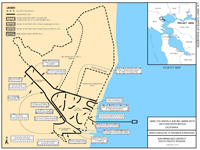
The project site is located on San Pablo Bay, four miles east of the city of Novato, Marin County, California. The project includes a 988-acre parcel with a former military airfield, adjacent California State Lands Commission areas, and the 1,612-acre Bel Marin Key Unit V (BMKV) parcel. The levee-protected site has subsided below the elevation of the surrounding properties, including the tidal wetlands immediately adjacent to San Pablo Bay. This project allowed for the beneficial use of 24.4 million cubic yards of dredged material, including 3.5 million cubic yards from the Port of Oakland 50' Deepening Project. This wetlands-restoration project can continue advance the beneficial use of dredge material from San Francisco Bay as part of the Long Term Management Strategy (LTMS) with the BMKV portion.
|
TOTAL FUNDING
|
|
|
TOTAL COST
|
$ 286,219,000
|
|
FEDERAL COST
|
$ 214,182,000
|
|
NON-FEDERAL COST
|
$ 70,037,000 |
|
|
|
|
TOTAL FEDERAL COST THROUGH FY 2020
|
$ 90,751,127
|
|
FY 2021 BUDGET
|
$ 0
|
|
FED COST TO COMPLETE
|
$ 123,430,873
|
FY 20 ACCOMPLISHMENTS (BASED ON AVAILABILITY OF FUNDS)
- Continued monitoring and adaptive management of the site to ensure project performance criteria is met, as required in the project permits and the Monitoring and Adaptive Management Plan (MAMP).
- In FY19, Year 4 of the 13 year monitoring and adaptive management phase, four years after breach, project performance, in general, is progressing well and on track to meet the project performance criteria set in the MAMP, with a few exceptions as described below. In summary:
- Delay in receipt of FY18 Workplan funds at the end of FY18 had various impacts to the site, including schedule, budget and on-site management. There was a 3 month lag in awarding the monitoring and nursery contract, which most notably impacted invasive vegetation control, water management of the north seasonal wetland and planting and caring for native seedlings, resulting in deterioration of native vegetation populations.
- The North Seasonal Wetland (NSW) is not performing as a seasonal wetland, due to a combination of factors including, over settlement of the berm after construction and excessive rainfall/king tides in 2017. This caused erosion of the berm, impacting performance of 20% of the site. The NSW is not on track to meet project performance set in the MAMP or site objectives.
- Native vegetation populations declined slightly and are still at risk from invasive species. Revegetation is critical to the success of the site and most vulnerable in the NSW due to poor project performance of the NSW berm.
- The tidal marsh shows nearly full tidal range, as sediment elevation rise, channels are beginning to form and is on track to meet project performance criteria set in the MAMP.
- Results of the bird and fish use at the site continues to be encouraging, with native populations dominating the landscape.
- Continued monitoring of the TAC’s Action List for adaptive management and other remedial actions which include, monitoring of the South Seasonal Wetland pond berm erosion, water management in the NSW and revegetation/invasive control.
- Public support and volunteers at the Hamilton Wetlands is a huge factor in meeting project performance criteria. Working to increase volunteer base to assist in recovery of lost native vegetation and increased invasive species control.
- Award Year 4 Monitoring Contract.
- Complete Year 3 – 2017 Monitoring Report.
- Hold Year 3 Technical Advisory Committee (TAC) meeting.
- Develop North Seasonal Wetland Berm repair plans and specs.
FY 21 ACCOMPLISHMENTS (BASED ON AVAILABILITY OF FUNDS)
- Begin Year 5 of the 13 year monitoring and adaptive management phase of the site to ensure project performance criteria is met, as required in the project permits and the Monitoring and Adaptive Management Plan (MAMP).
- Award Year 5 Monitoring Contract.
- Complete Year 4 – 2018 Monitoring Report.
- Hold Year 4 Technical Advisory Committee (TAC) meeting.
- Award North Seasonal Wetland Berm construction contract.
- Complete construction of the North Seasonal Wetland Berm.
- Continued development to increase the number of volunteers through public outreach.
ISSUES AND OTHER INFORMATION
CONGRESSIONAL INTEREST
- 2nd District, Rep. Jared Huffman
- Senator Kamala Harris
- Senator Diane Feinstein
POINT OF CONTACT
- Deputy for Project Management, Edwin S. Townsley, (415) 503-6593.
Updated on 16 January 2020
Click Map to Zoom In